Best GIC Rates in Canada (November 2026)
Rates verified November 18, 2026. Every rate in the table below was read directly from that provider's own published rate page — WealthONE (wealthonebankofcanada.com/Invest/GICs, effective October 26, 2026), Saven Financial (savenfinancial.ca/en/on-rates), Oaken Financial (oaken.com/en/rates, effective November 6, 2026), Tangerine (tangerine.ca/en/rates/gic-rates), EQ Bank (eqbank.ca/rates, effective November 18, 2026), RBC (rbcroyalbank.com/investments/gic-rates.html, current for November 16, 2026) and TD (td.com/ca/en/personal-banking/personal-investing/products/gic/non-cashable-gic-rates). Always confirm current rates directly with the financial institution before purchasing.
Quick Picks
| Term | Best Rate | Provider | CDIC Insured |
| 1-year GIC | 4.05% | WealthONE | ✅ |
| 2-year GIC | 4.30% | WealthONE | ✅ |
| 3-year GIC | 4.40% | WealthONE | ✅ |
| 5-year GIC | 4.55% | WealthONE | ✅ |
Full Rate Comparison
| Provider | 1-Year | 2-Year | 3-Year | 5-Year | Min Deposit | CDIC | Redeemable Option |
| WealthONE | 4.05% | 4.30% | 4.40% | 4.55% | $1,000 | ✅ | No |
| Saven Financial | 4.00% | 4.25% | 4.30% | 4.50% | $1,000 | ✅ (FSRA) | No |
| Oaken Financial | 3.90% | 4.30% | 4.35% | 4.50% | $100 | ✅ | 1yr cashable at 2.25% |
| Tangerine | 3.60% | 3.85% | 3.95% | 4.05% | $1 | ✅ | No |
| EQ Bank | 3.70% | 4.10% | 4.00% | 4.25% | $100 | ✅ | No |
| RBC | 3.00% | 3.20% | 3.30% | 3.55% | $500 | ✅ | Yes (lower rate) |
| TD | 3.00% | 3.20% | 3.30% | 3.55% | $500 | ✅ | Yes (lower rate) |
Rates verified November 18, 2026 directly from each provider's own rate page. WealthONE GIC rates (wealthonebankofcanada.com/Invest/GICs, effective October 26, 2026): 1yr 4.05%, 18mo 4.10%, 2yr 4.30%, 3yr 4.40%, 4yr 4.45%, 5yr 4.55%. Saven Financial GIC rates (savenfinancial.ca/en/on-rates): 4mo 3.00%, 6mo 2.75%, 1yr 4.00%, 2yr 4.25%, 3yr 4.30%, 4yr 4.35%, 5yr 4.50%. Oaken Financial GIC rates (oaken.com/en/rates, effective November 6, 2026): 1yr 3.90%, 18mo 3.95%, 2yr 4.30%, 3yr 4.35%, 4yr 4.40%, 5yr 4.50%. Tangerine GIC rates (tangerine.ca/en/rates/gic-rates, verified November 16, 2026): 1yr 3.60%, 18mo 3.75%, 2yr 3.85%, 3yr 3.95%, 4yr 4.00%, 5yr 4.05%. Tangerine cut its GIC ladder after our November 9 check — the 1-year rate fell from 3.70% to 3.60% and the 5-year from 4.20% to 4.05%. EQ Bank GIC rates (eqbank.ca/rates, effective November 18, 2026): 1yr 3.70%, 15mo 3.80%, 2yr 4.10%, 27mo 4.00%, 3yr 4.00%, 4yr 4.10%, 5yr 4.25%. EQ Bank cut its GIC ladder on November 18, 2026 — the 2-year fell from 4.15% to 4.10%, the 3-year from 4.15% to 4.00%, and the 5-year from 4.30% to 4.25%. RBC non-redeemable GIC rates (rbcroyalbank.com/investments/gic-rates.html, current for November 9, 2026): 1yr 3.00%, 2yr 3.20%, 5yr 3.55%. TD long-term non-cashable GIC rates (td.com/ca/en/personal-banking/personal-investing/products/gic/non-cashable-gic-rates): 1yr 3.00%, 2yr 3.20%, 3yr 3.30%, 4yr 3.35%, 5yr 3.55%. Motive Financial was removed — it now redirects to National Bank Direct Brokerage and no longer offers a GIC line of its own. The gap between online banks and the Big Five is wider than it was a year ago: a $10,000 1-year GIC at WealthONE earns $405 vs $300 at TD and RBC.
Secure Top GIC Rates at EQ Bank →Competitive GIC rates + CDIC insured. Opens on EQ Bank's secure website.
Claim Your Tangerine Bonus →Use Orange Key: 38687402S1 for a cash bonus, then open a GIC. Opens on Tangerine's secure website.
What Is a GIC?
A Guaranteed Investment Certificate locks in your money for a fixed term (30 days to 10 years) at a guaranteed interest rate. Unlike stocks or ETFs, your principal is 100% safe — you cannot lose money on a GIC.
In 2026, GICs offer higher guaranteed returns than any point in the 2010-2022 era, making them a compelling option for short-term savings goals, emergency funds, or the conservative portion of a retirement portfolio.
GIC Types Explained
| Type | Best For | Trade-Off |
| Non-redeemable | Maximum rate, known timeframe | Can't access money before maturity |
| Cashable/Redeemable | May need money early | Lower rate (typically 1-3% less) |
| Market-linked | Potential for higher returns | Returns not guaranteed; could be 0% |
| Escalating rate | Rising rate expectations | Starts lower, increases each year |
| Foreign currency | USD savings, snowbirds | Currency risk; no CDIC |
For most Canadians, a standard non-redeemable GIC from an online bank offers the best combination of rate and simplicity.
The GIC Ladder Strategy
Rather than locking all your money in one 5-year GIC, divide it across staggered terms:
- 20% in a 1-year GIC at 4.05%
- 20% in a 2-year GIC at 4.30%
- 20% in a 3-year GIC at 4.40%
- 20% in a 4-year GIC at 4.45%
- 20% in a 5-year GIC at 4.55%
Each year, one GIC matures. You can reinvest at current rates or use the cash. This gives you both higher rates and annual liquidity.
GIC vs HISA: When Does a GIC Win?
| GIC | HISA | |
| Rate | 3.00–4.55% (locked) | 2.75–3.25% (variable) |
| Liquidity | Locked until maturity | Withdraw anytime |
| Rate guarantee | Full term | Changes with BoC policy |
| Best for | Known timeframe, max rate | Emergency fund, short-term needs |
Rule of thumb: If you know you won't need the money for 12+ months, a GIC typically beats a HISA. If the money is your emergency fund, keep it in a HISA — the liquidity is worth the ~1.00% rate difference.
See our Best HISAs in Canada → for current savings account options.
CDIC and Deposit Insurance
!CDIC Deposit Insurance Coverage Diagram
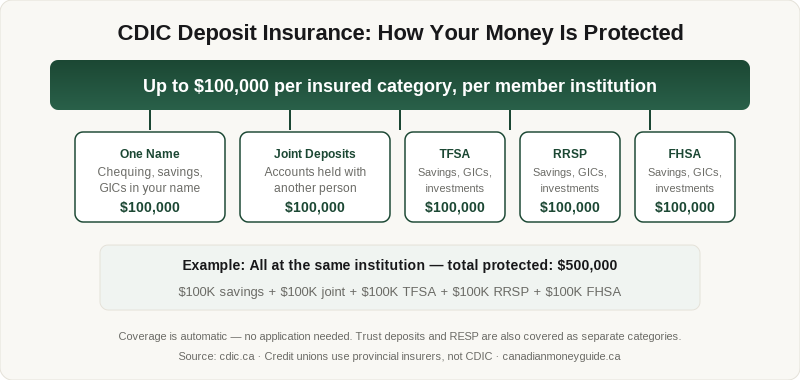
GICs from CDIC member institutions are insured up to $100,000 per insured category, per institution. If you have more than $100,000 in GICs, spread it across multiple institutions or account types (TFSA, RRSP, non-registered are separate categories).[1]
Credit unions offer provincial deposit insurance (usually unlimited in provinces like Manitoba, $250,000 in BC, etc.) — verify your province's coverage.[2]
FAQ
Are GIC rates going up or down? As of November 2026, rates have climbed back off their 2024 lows and remain well below their 2023 peaks. The Bank of Canada overnight rate largely drives GIC rates, and its 25 basis point hike to 2.50% on October 28, 2026 has already fed through to posted curves. The yield curve is slightly positive — short-term GICs (1-year at 4.05% via WealthONE) yield less than longer terms (5-year at 4.55%), which is normal when markets expect rates to stay elevated for longer.[3]
Can I hold a GIC in my TFSA or RRSP? Yes. Interest is tax-free in a TFSA and tax-deferred in an RRSP. This is especially valuable at current rates — 4.55% tax-free on a 5-year GIC beats a taxable account.
What happens when a GIC matures? Most institutions auto-renew into a similar term at current rates (typically lower promotional rates). Set a calendar reminder and shop around at maturity — don't let it auto-renew without checking current rates.
Can I break a non-redeemable GIC early? Technically no, but most banks allow early redemption in cases of financial hardship (job loss, medical emergency). You'll forfeit all or most of the interest earned. Assume the money is locked until maturity.
Are online bank GICs safe? Yes. WealthONE, EQ Bank, Oaken, Saven Financial, and Tangerine are all CDIC members — your deposits are insured identically to the Big Five. There's no safety difference between a WealthONE GIC and a TD GIC.
Next Steps
Best High-Interest Savings Accounts → — If you need liquidity, compare current HISA rates.
How to Build an Emergency Fund → — How much cash should you keep accessible before locking money in a GIC?
TFSA vs RRSP vs FHSA → — Which registered account should hold your GICs?
Disclaimer: GIC rates verified as of November 16, 2026 against each provider's own published rate page — WealthONE, Saven Financial, Oaken Financial, Tangerine, EQ Bank, RBC, and TD. Always confirm current rates directly with the financial institution before purchasing. This article does not constitute financial advice. CDIC insurance limits and coverage details are available at cdic.ca.
Footnotes
- CDIC deposit insurance covers GICs issued by member institutions up to $100,000 per insured category, per institution. Source: cdic.ca ↩
- Provincial deposit insurance limits vary. BC: CUDIC (unlimited). Manitoba: DGCM (unlimited). Ontario: FSRA (unlimited non-registered, $250K registered). Quebec: AMF ($100K). Alberta: Credit Union Deposit Guarantee Corporation (unlimited). ↩
- Bank of Canada overnight rate is 2.50% as of November 9, 2026 (raised 25 basis points from 2.25% on October 28, 2026, the first hike since 2023). The next scheduled announcement is December 9, 2026. GIC rates typically price 1.0-1.75% above the overnight rate depending on term length and institution competition. Source: bankofcanada.ca ↩